Designing a Debug Board for ADX, Finding Elegance in Simplicity
Designing a Debug Board for ADX: Finding Elegance in Simplicity
I am currently developing ADX (Advanced Devices eXtended), a project that utilizes an expansion standard via IDC ribbon cables. To facilitate testing of the ADX Core V0 using an Analog Discovery 3, I recently started rethinking the best way to design a dedicated expansion board for pin header access.
The Struggle with "Standard" Constraints
My initial plan was to design a debug board that strictly followed the ADX expansion standard—an 85mm x 60mm footprint. However, the more I looked at the design, the more "inelegant" it felt.
The goal was simple: just break out a 2x12 pin header. Using a full-sized board for such a minimal task resulted in unnecessarily long traces and a lot of wasted PCB real estate. It felt like I was forcing a solution into a box where it didn't belong.
Exploring (and Rejecting) Feature Creep
In an attempt to justify the board size, I considered several "value-add" ideas:
- Adding a universal prototyping area (like a breadboard).
- Incorporating ferrule terminal blocks for multi-purpose connectivity.
While these sounded good on paper, I soon realized they were drifting away from the core requirement. Worse, these additions could potentially degrade the signal integrity—the very thing that needed to remain "rock solid" for reliable debugging.
The Epiphany: Stability vs. Accessibility
I eventually realized the root of the problem: I wanted direct debug access on the ADX Core V0 itself. However, adding nearly 20 GPIO debug pins directly onto the main board was a non-starter. Doing so would likely introduce instability during high-speed operations, which is the last thing you want on a core system board.
The Conclusion: Back to Basics
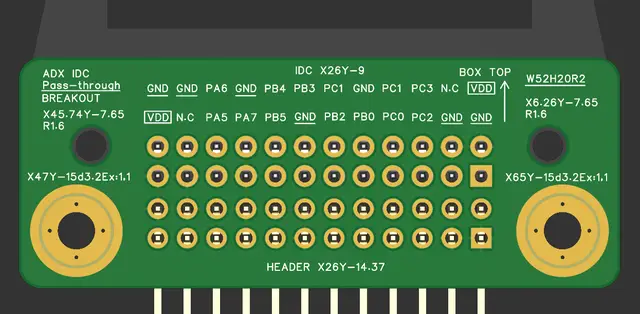
After weighing the pros and cons, I decided to pivot. Instead of trying to force a debug tool into the "Expansion Board" form factor, I opted for a specialized Breakout Board.
The final direction is a simple, focused interface that converts the IDC ribbon cable directly into pin headers. By moving away from the rigid expansion standard for this specific tool, I’ve achieved a design that is compact, high-integrity, and—most importantly—perfectly suited for its purpose.
Sometimes, the best engineering isn't about adding more features; it's about knowing when to strip them away.
#adx #card #debug #test